Work X-hunt
Designing an AI-assisted network where people stay in control
X-hunt began with a practical observation: plenty of people would happily give a few hours to the right thing, but they are rarely asked — and asking or being asked can feel risky. The product is built around the reasons good people hold back.
- Role
- Co-founder & product lead — research, product definition, design and build
- When
- Independent venture
- Status
- Live pilot with a small number of communities
- Live
- xhunt.app
Problem
People with useful skills rarely get asked to help; community organisations struggle to make needs visible and to coordinate contributors without exposing anyone.
What I did
Defined the product from research, designed the consent architecture and the assistant’s boundaries, and lead the build of a production web app.
Outcome
Live and in pilot. Privacy-by-default, double opt-in introductions and a bounded assistant are all observable in the product today. Adoption metrics are not yet published.
The problem
Willingness to contribute is not the bottleneck. Trust is.
My research — stakeholder conversations, surveys, empathy mapping and iterative concept testing — looked at both sides: individuals who want to contribute, and community organisations trying to coordinate them. Participation depended on more than matching skills. Trust, motivation, time, accessibility, belonging and recognition decided whether someone took part and came back.
Two things recurred: people did not want to be chased, and they did not want their details passed around.
People did not want to be chased, and they did not want their details passed around.
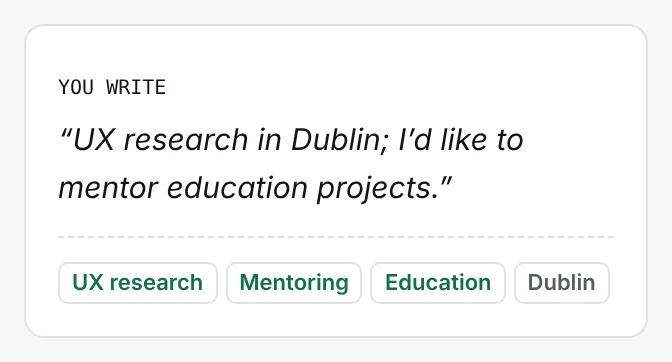
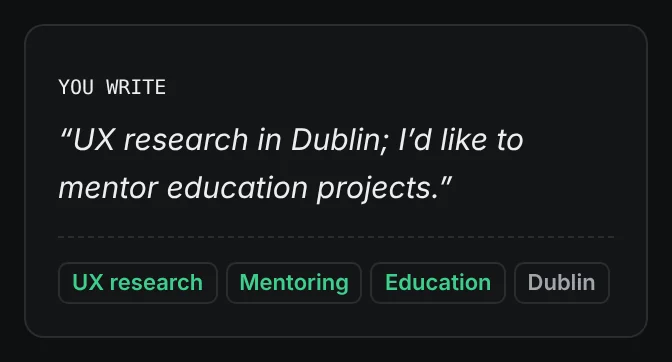
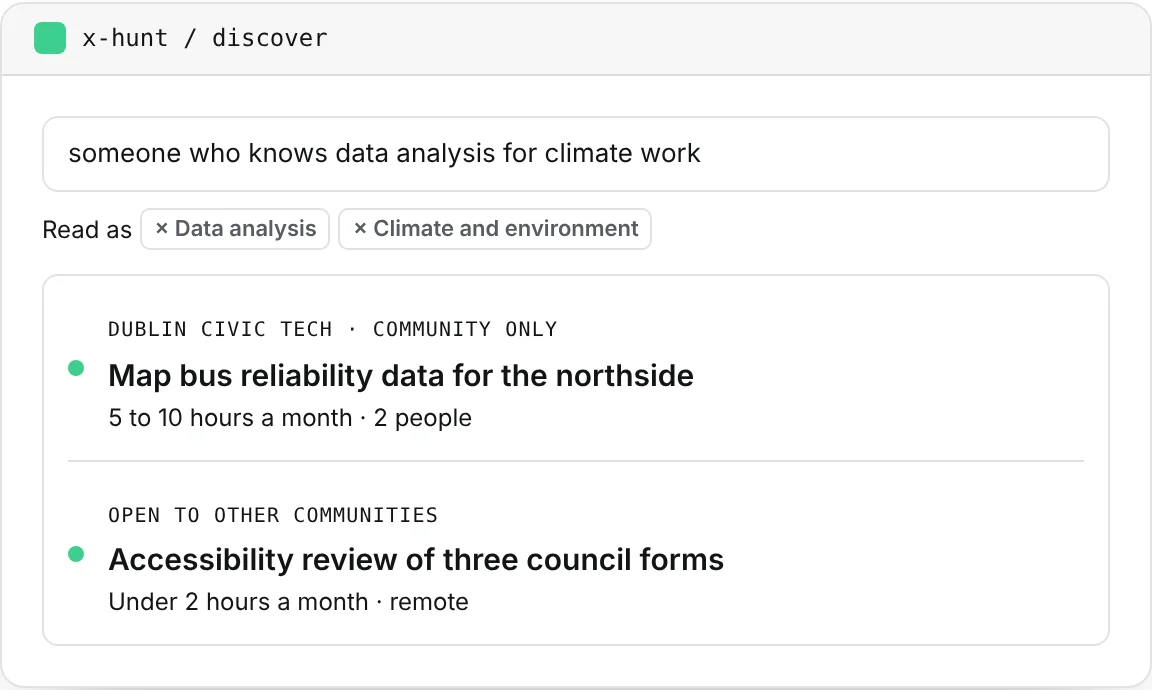
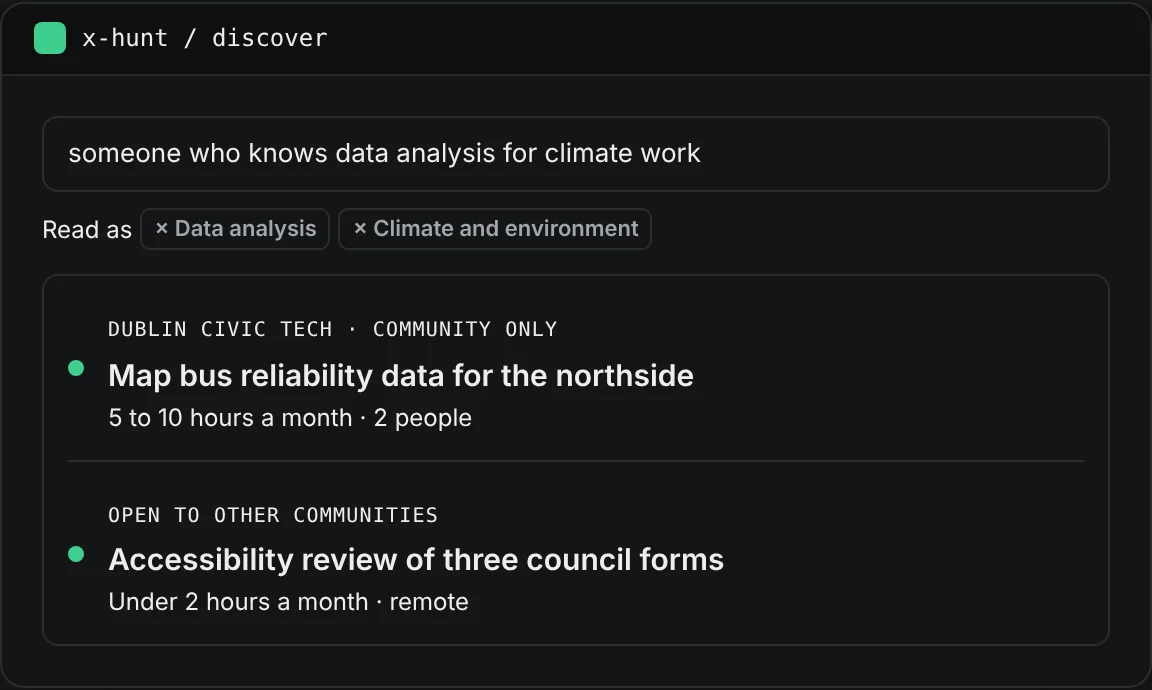
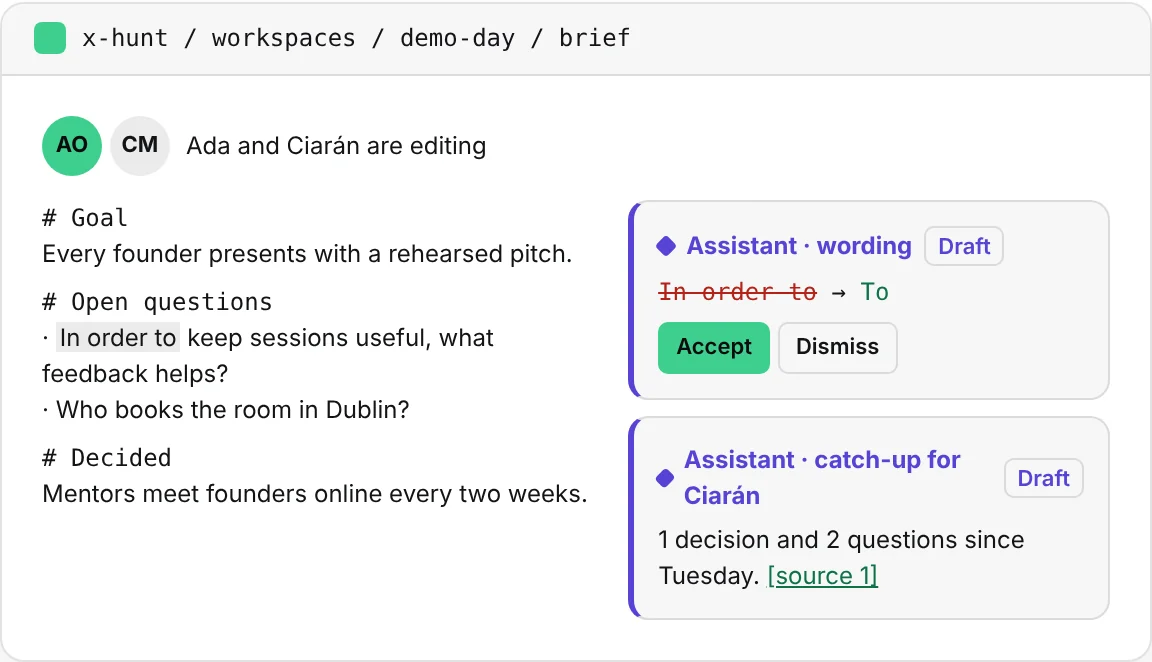
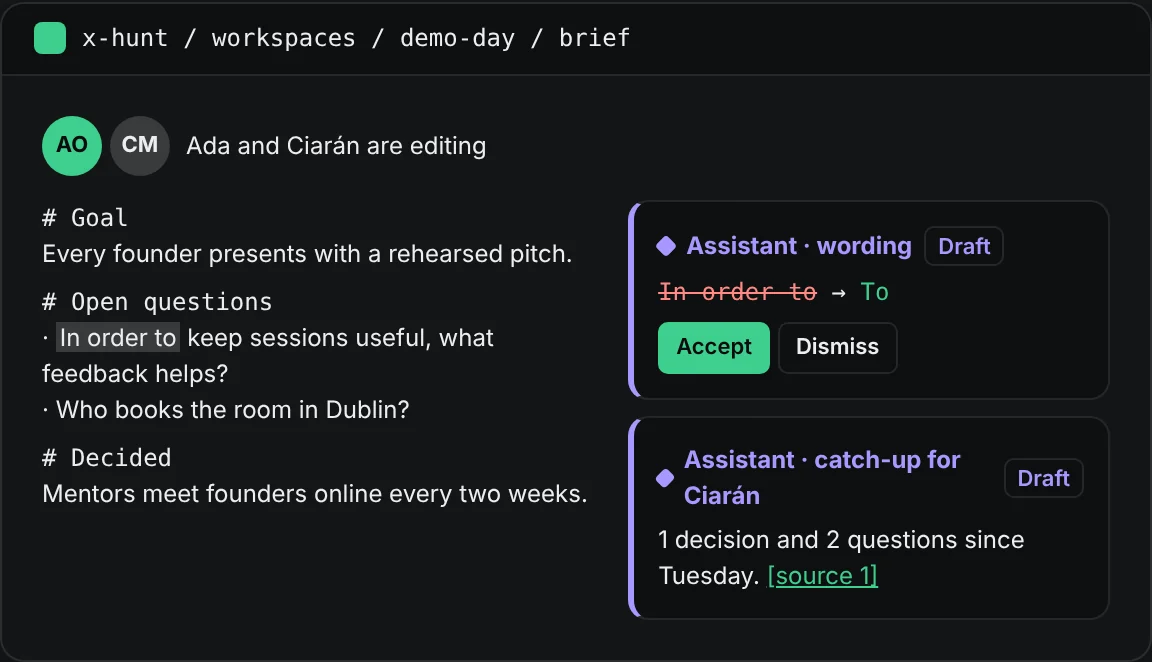
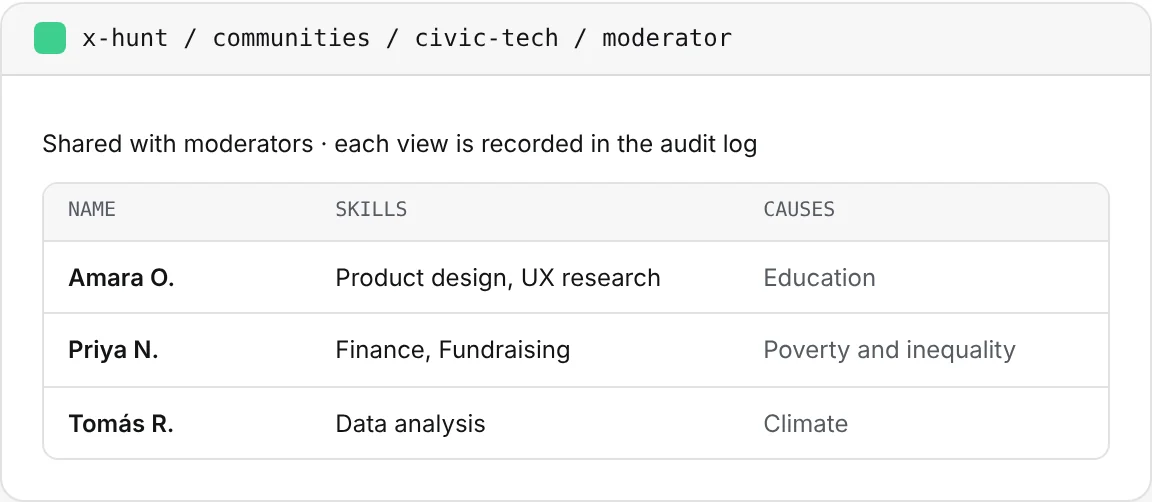
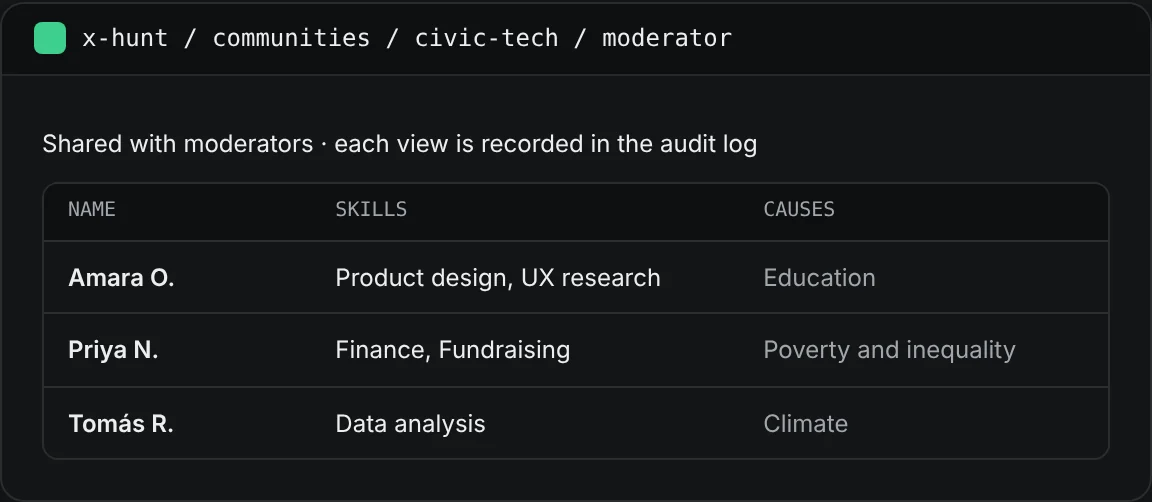
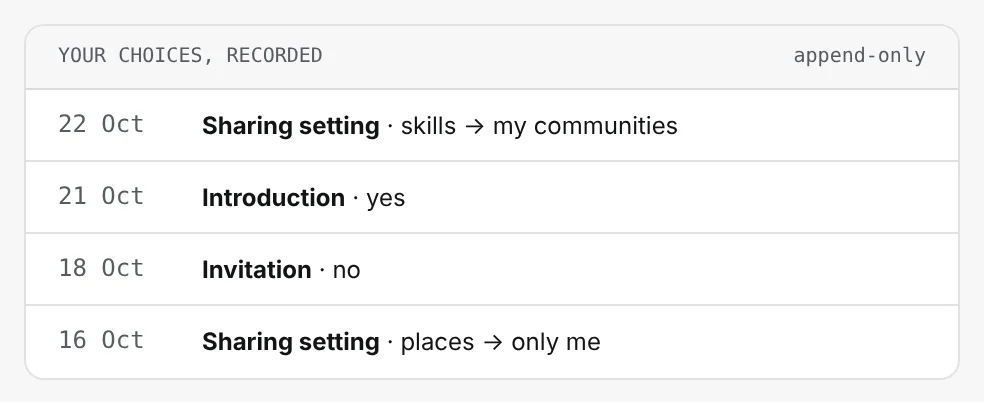
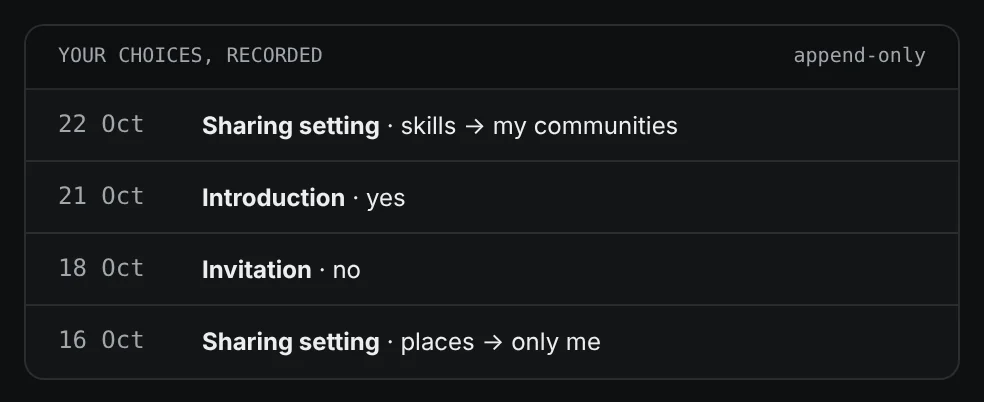
What a person actually sees.
Illustrations from xhunt.app’s public landing page, rendered from the product’s own interface components. People, communities and content are fictional. Shown in the current theme.
The direction
Contribution, not community, is the way in.
A person with no affiliation should be able to start from what they want to contribute to. The product therefore has two entry points — individual-led and community-led — and the individual path starts with a single sentence rather than a CV or a membership.
From there, every design choice protects agency: nothing is shared until the person chooses, introductions need two yeses, and the AI assistant has hard limits on what it may do.
Making it real
The boundaries people feel are the ones that ship.
Research is written to be argued with. The landing-page study states its hypotheses, weighs each source and names the counterevidence — incumbents exist, and stated willingness is not behaviour. It ends with a rule: the page may not promise anything the product does not do.
Because I design and build the interface, the limits I draw on paper survive into production. A suggestion is always a labelled draft with Accept and Dismiss. A search shows how it read your words, and lets you remove that reading. A moderator view says that every look is recorded.
The pilot is deliberately small. The next question is behavioural: do people finish the first sentence, open sharing to their communities, and say yes to a first opportunity?
Decisions and trade-offs
- 01
Private by default, shared field by field
Fear of exposure was a reason people held back. Every part of a profile starts as “Only me”, and the person opens it up piece by piece.
- Instead of
- A public profile with privacy settings to opt out of.
- Trade-off
- Less data visible to communities at first; much lower risk of the first interaction feeling unsafe.
- 02
Introductions need two yeses; no is silent
Being asked should not feel risky. Neither person sees the other until both agree, and declining sends no signal.
- Instead of
- Direct messaging or one-sided requests.
- Trade-off
- Slower first connection; no pressure or social cost attached to saying no.
- 03
The assistant drafts — it never introduces, ranks or decides
AI is useful for turning a sentence into a draft or a search into filters. It is not appropriate for judging people. Its output is labelled and editable; it can be paused, and the product works on simple rules without a model.
- Instead of
- AI-driven matching and recommendations.
- Trade-off
- Gives up algorithmic matching as a growth lever, in exchange for an explicit, explainable boundary on automation.
- 04
No rankings; aggregate only with three or more people
Scores and leaderboards would change why people contribute. Communities see totals only when three or more people choose to share.
- Instead of
- Leaderboards and individual contribution scores.
- Trade-off
- Less gamification; recognition that does not expose individuals.
What happened
Product status
Live, in a pilot with a small number of communities (xhunt.app, November 2026)
Visible in the live productTrust model
Private-by-default profiles, double opt-in introductions and an append-only record of sharing choices are live
Visible in the live productAdoption and activation
Not yet measured publicly; pilot instrumentation counts broad page groups only, with consent
Not measured
Designing the boundaries of an AI feature is a product decision, not a disclaimer. What the assistant refuses to do is as much a part of the experience as what it does.
The test of the design is behavioural: whether a person who arrives with one sentence ends up contributing — and whether communities trust the product enough to bring their members.
Role, team and how this was validated
Owned
- Product definition and requirements
- Consent architecture and privacy model
- Assistant behaviour and limits
- Interface design, design tokens and motion
- Direction of the build, decision records and acceptance criteria
Influenced
- Pilot design with partner communities
- Technical architecture decisions
- AI use policy
Worked with
- Co-founder partnership
- Pilot communities and stewards
- AI coding agents, working to the repository’s rules
Build and validation
I direct the build with AI coding agents; most commits in the repository are co-authored with them. The guard-rails are written down as decision records — authentication, tenant isolation, one AI gateway with rules first, design tokens and motion.
On 23 October 2026 the end-to-end acceptance suite passed 33 of 33 checks against a production build, on three consecutive runs, with the AI provider switched off. Catch-up summaries, wording suggestions and plain-language search all have rule-based paths.
Hard-coded colour values were replaced with a token system whose contrast rules are recorded as a decision.
- Acceptance testing: 33 of 33 end-to-end checks passed on a production build, three consecutive runs, AI provider off (23 October 2026)
- Architecture decisions: Eight accepted decision records and one proposed, including “One AI gateway, rules first”, tenant isolation and design tokens
Each result is labelled by how it is known. Diagrams are drawn for this portfolio to explain the design reasoning; they are not client deliverables or screenshots of shipped systems. Interface images are rendered from the product’s own components with fictional data.
Next — Fidelity Bank